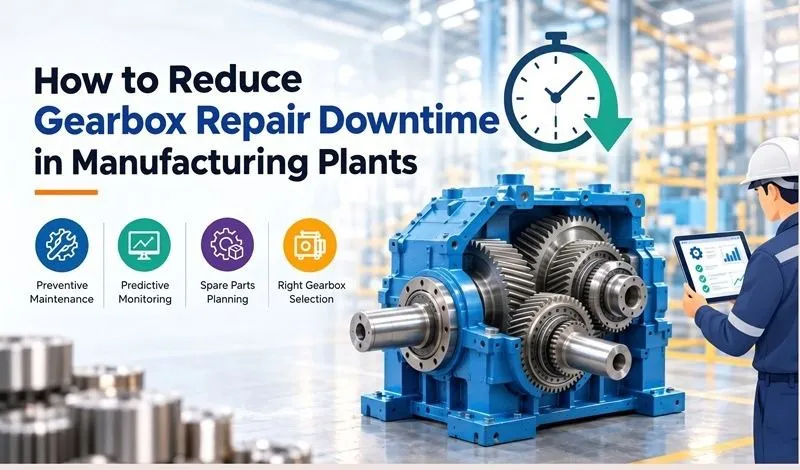
How to Reduce Gearbox Repair Downtime in Manufacturing Plants
An entire production line can be stopped due to gearbox failure. As long as the gearbox remains out of service, the more production time your plant can lose. For this reason, reducing gearbox repair downtime is not only about getting a failed unit back into operation quickly. It is also about identifying the causes of failure and taking steps to prevent the same problem from happening again.
Many gearbox problems can be linked to factors such as incorrect lubrication, misalignment, excessive loads, poor installation, inadequate maintenance, or selecting a gearbox that does not match the application. Regular inspection and timely maintenance can help identify these issues before they result in an unexpected breakdown.
These are the common causes of gearbox failures, practical maintenance measures, and factors to consider when selecting a gearbox for your application. Whether you operate a cement plant, sugar mill, conveyor system, packaging line, or another industrial setup, these practices can help improve gearbox reliability and reduce unplanned repair time.
Choosing a gearbox from an experienced manufacturer and specifying it correctly for the operating conditions can also help reduce avoidable failure risks. Premium Transmission manufactures industrial gearboxes in India, with solutions designed for a range of industrial applications.
The Real Cost of Gearbox Repair Downtime in Manufacturing
When a gearbox breaks down, the repair bill is only one part of the cost. Sometimes you may have to pay for replacement parts, technicians, labour, and for other various services, but the production loss during the stoppage can add much more to the overall impact.
A sudden gearbox failure can stop the equipment connected to the gearbox and delay the production schedule. When your orders are already planned, the delay may also create additional pressure on delivery timelines. In some cases, plants may need extra shifts or overtime to make up for lost production.
There can also be further repair costs when a gearbox failure causes damage to related components. Finding signs of wear, overheating, lubrication problems, or other issues during routine inspections gives maintenance teams a chance to address them before they develop into a major breakdown.
For this reason, reducing gearbox repair downtime is not simply about repairing a failed gearbox quickly. Regular maintenance, timely inspections, and choosing a gearbox that suits the application can help reduce the risk of unexpected stoppages and keep production running more consistently.
| Industry | Estimated Downtime Cost per Hour | Critical Drive Equipment |
|---|---|---|
| Cement plant | ₹2-5 lakh per hour | Kiln drive, raw mill, ball mill, belt conveyors |
| Sugar mill (crushing season) | ₹3-8 lakh per hour | Cane carrier, mill drive, juice processing |
| Steel rolling mill | ₹5-15 lakh per hour | Pinion stand, coiler/uncoiler, transfer conveyors |
| Packaging line | ₹50,000-2 lakh per hour | Filling, sealing, labelling, palletising drives |
| Mining conveyor | ₹1-4 lakh per hour | Head drive, take-up drive, transfer towers |
| Water treatment plant | Regulatory/supply risk | Sluice gates, pump drives, agitators |
These figures make the case for investment in maintenance and correct gearbox specification. A ₹15,000 oil change that prevents a ₹3 lakh gearbox failure, plus two days of lost production, pays for itself many times over.
Disclaimer: These costs are approximate estimates and may vary depending on the condition of the gearbox.
Root Causes of Gearbox Failure: What Usually Goes Wrong
Gearbox failures rarely happen without a reason. In many cases, the problem starts with something that could have been identified or corrected earlier. Poor lubrication, misalignment, excessive loading, contamination, and installation problems are common factors that can shorten gearbox life.
- Poor or incorrect lubrication: Using the wrong oil grade, allowing the lubricant to become contaminated, running with degraded oil, or missing scheduled oil changes can increase wear on gears and bearings. The lubricant needs to be suitable for the gearbox and its operating conditions.
- Shaft misalignment: If the gearbox shaft and the connected machine are not properly aligned, the gearbox can experience uneven loads. This can increase bearing and seal wear and may also result in abnormal vibration and noise.
- Excessive loading: A gearbox should be selected according to the actual load and operating conditions of the machine. Shock loads, frequent starts and stops, and other demanding conditions need to be considered when determining the required gearbox rating and service factor. Operating beyond the gearbox’s rated capacity can damage gears, shafts, bearings, or other components.
- Contamination: Dust, dirt, water, and other contaminants can enter a gearbox through damaged seals, breathers, or poor maintenance practices. Contaminated lubricant can increase wear on gear teeth and bearings, particularly in dusty or humid operating environments.
- Installation mistakes: Incorrect installation can create problems even when the gearbox itself is correctly specified. Poor alignment, incorrect mounting, improper sealing, or installing the gearbox in an unsuitable position can affect lubrication, bearings, seals, and other components.
The important point is that many gearbox problems can be addressed before they become major failures. Correct gearbox selection, proper installation, suitable lubrication, regular inspection, and timely maintenance can all help reduce avoidable downtime and extend gearbox service life.
Warning Signs Your Gearbox Needs Attention
Catching problems early, before a full breakdown, is the difference between a planned maintenance stop and an emergency shutdown. Train your operators to watch for these signals:
| Warning Sign | Likely Cause | Urgency |
|---|---|---|
| Unusual noise, whining, grinding, clicking | Gear tooth wear, bearing failure, contamination | Inspect within 24 hours |
| Elevated housing temperature (>80°C without load change) | Lubrication failure, overloading, bearing friction | Inspect immediately |
| Oil leaks at seals or gaskets | Seal wear, housing crack, overpressure from blocked breather | Inspect within 48 hours |
| Increased vibration at couplings | Misalignment, bearing wear, gear tooth damage | Inspect within 24 hours |
| Discoloured or metallic-particle oil | Gear tooth or bearing wear, contact fatigue | Oil sample analysis, urgent |
| Output speed variation under constant load | Tooth breakage, loose coupling, shaft key failure | Stop and inspect immediately |
| Housing condensation or milky oil | Water ingress through breather or seals | Drain and change oil, within 1 shift |
Preventive Maintenance: The Baseline Strategy to Reduce Downtime
A structured preventive maintenance (PM) programme addresses the top failure causes before they cause breakdown. Here is a practical PM schedule for industrial gearboxes:
Daily/Shift Checks
- Visual inspection: Check for oil leaks, unusual noise, or vibration changes. Record observations.
- Temperature check: check or use a laser thermometer on the housing; flag any significant rise from normal operating temperature.
- Oil level check: Where a dipstick or sight glass is fitted, confirm oil level is within the operating range.
Monthly Checks (Maintenance Team)
- Oil quality check: Take out a sample of oil and inspect for colour change, metallic particles, or water content. Milky oil means water mixed with the oil, in this case, change the oil immediately.
- Coupling and shaft alignment check: Use a dial gauge or laser alignment tool to verify alignment within manufacturer tolerance.
- Breather valve inspection: Confirm the breather is not blocked, a blocked breather causes pressure build-up that blows seals.
- Fastener torque check: Re-torque mounting bolts and coupling fasteners to specified values.
Annual Overhaul (Mechanical Team or OEM Service)
- Full oil drain and refill: Use manufacturer-specified EP gear oil at the correct viscosity grade for your operating temperature range.
- Seal replacement: Replace input and output shaft seals as standard, they are low-cost and prevent the highest-consequence contamination failures.
- Bearing inspection: Check bearing preload and condition. Replace if any roughness, pitting, or discolouration is found.
- Gear tooth visual inspection: Check for pitting, spalling, micropitting, or tooth fracture on accessible gear sets.
- Housing crack check: Inspect housing for hairline cracks, particularly around bearing bores and mounting flanges.
Predictive Maintenance: Moving Beyond Scheduled Intervals
Predictive maintenance (PdM) uses condition monitoring data to schedule maintenance based on the actual condition of the gearbox, not a fixed calendar interval. This reduces unnecessary maintenance stops while giving earlier warning of developing faults.
| PdM Technique | What It Detects | Cost to Implement |
|---|---|---|
| Vibration analysis (accelerometer) | Bearing wear, gear tooth damage, misalignment, resonance | Low, handheld analyser, ₹20,000 – 1 lakh |
| Oil particle counting | Metal wear particles indicating gear or bearing wear | Medium, oil sampling kit or lab service |
| Thermal imaging | Bearing hot spots, lubricant failure zones, overloaded sections | Low, IR thermometer or camera, ₹5,000-50,000 |
| Acoustic emission sensing | Early-stage micro-cracks and surface fatigue, before audible noise | Medium-high, specialist sensors required |
| Continuous temperature monitoring | Sustained overheating – oil breakdown or overloading trend | Low, thermocouple + data logger, ₹3,000-15,000 |
Even basic vibration analysis using a handheld analyser, performed monthly by a trained maintenance technician, consistently identifies developing bearing and gear faults 4-8 weeks before failure, giving sufficient time for a planned maintenance stop rather than an emergency breakdown.
Spare Parts Strategy: Eliminating Lead-Time Downtime
A significant proportion of gearbox repair downtime is not the repair itself, it is waiting for spare parts. Many Indian manufacturers lose 3-7 days per breakdown waiting for components to arrive from distributors or manufacturers. A disciplined spare parts inventory strategy eliminates this.
Minimum recommended critical spares for industrial gearboxes:
- Oil seals input and output: Cheap, high-failure risk, and unavailable at most local hardware shops. Stock at least two sets per gearbox type in your plant.
- Input and output shaft bearings: The most common mechanical failure point. Keep one set of each bearing size per critical drive.
- Worm wheel: Bronze worm wheels are consumable items, they wear sacrificially to protect the worm shaft. A replacement worm wheel should always be on-site for critical drives.
- Breather valve: Blocked breathers cause seal failures. Stock 2-3 per plant.
- Coupling elements: Flexible coupling inserts degrade under vibration, stock spares to avoid misalignment-induced gearbox damage.
Premium Transmission supplies genuine spare parts for all our gearbox models. Contact our spares and service team for a parts list and recommended inventory levels for your specific gearbox models.
How Choosing the Right Gearbox Can Reduce Long-Term Downtime
Gearbox reliability starts with selecting the right unit for the application. The gearbox needs to match the required torque, speed, load, duty cycle, mounting arrangement, operating environment, and other application conditions. Choosing a suitable gearbox at the design stage can help reduce excessive wear, overheating, and other problems that may lead to unplanned downtime.
A gearbox that is not properly matched to the application can face unnecessary loads and operating stress, even when regular maintenance is carried out. This is why gearbox selection should consider the actual working conditions rather than relying only on motor power or basic speed requirements.
Standard Helical Gearbox for Continuous Industrial Drives
Premium Transmission’s Standard Helical Gearboxes are suitable for a range of continuous industrial applications, including conveyors, pumps, fans, and process equipment. Helical gears have angled teeth that engage progressively, allowing smooth transmission of power and helping maintain reliable operation when the gearbox is correctly selected for the application.
For continuous-duty equipment, factors such as load, operating hours, required output speed, torque, lubrication, and service factor should be considered during gearbox selection. Choosing the correct rating helps the gearbox operate within its intended working range.
Planetary Gearbox for Compact, High-Torque Applications
Modular Planetary Gearboxes are designed for applications that require high torque from a relatively compact gearbox arrangement. Their coaxial design can be useful where installation space is limited, while the planetary gear arrangement allows the load to be distributed through multiple gears.
They can be considered for demanding applications such as agitators, extruders, and heavy-duty conveyors, provided the gearbox is correctly sized for the required torque, speed, duty cycle, and operating conditions.
The right choice between a helical and planetary gearbox depends on the application rather than simply the gearbox type. Reviewing the operating requirements before selection can help reduce unnecessary stress on the transmission system and support more reliable long-term operation.
PT’s Support to Reduce Your Plant Downtime
As established gearbox manufacturers in Pune, Premium Transmission offers more than just the equipment:
- Application engineering: We help specify the correct gearbox including service factor, mounting, thermal rating, and lubrication – eliminating under-specification failures at the source.
- ISO 9001 certified manufacturing: Consistent dimensional accuracy and material quality means our gearboxes perform to specification from day one.
- Spare parts supply: Genuine spare parts from our four manufacturing plants in Pune – available for dispatch across India.
- Technical support: Our engineers can review your current gearbox failures, identify root causes, and recommend corrective action.
Frequently Asked Questions
How do I reduce gearbox repair downtime in my manufacturing plant?
The most effective approach combines three layers like, correct gearbox specification from the start right service factor, correct ratio, appropriate mounting, structured preventive maintenance correct lubrication, alignment checks, seal inspection, and a spare parts inventory that eliminates waiting time when a replacement is needed. Most unplanned gearbox failures are preventable with these three practices in place.
What causes most gearbox failures?
The top causes are lubrication failure wrong oil, contaminated oil, or missed oil changes, accounts for 40–50% of failures, shaft misalignment at installation 15-20%, and overloading beyond the rated service factor 15-20%. Together these three account for over 80% of premature gearbox failures in industrial plants.
How do you maintain a gearbox?
Gearbox maintenance has three levels: daily operator checks noise, temperature, oil level, monthly maintenance team checks oil quality, alignment, breather, fasteners, and annual overhaul oil drain and refill, seal replacement, bearing inspection, gear tooth visual check. The exact intervals depend on the gearbox type, duty, and operating environment, always refer to the manufacturer’s maintenance schedule.
Why gearbox is used with a motor?
An electric motor runs at a fixed high speed (typically 960–1500 RPM for 4 or 6-pole motors). Most industrial driven machines, conveyors, mixers, pumps, agitators, need much lower shaft speeds and much higher torque than the motor alone can provide. The gearbox reduces speed and multiplies torque between the motor and the driven machine, matching the motor output to the application requirement.
How does a gearbox get damaged?
Gearboxes are damaged primarily by lubrication failure (oil breakdown, contamination, or starvation), overloading (torque peaks beyond the design rating), water or dust ingress through failed seals, misalignment causing uneven bearing loads, and installation errors such as incorrect bearing preload. Running a gearbox past its thermal rating, common in continuous high-duty applications, also accelerates oil degradation and wear.
Why gearbox is used in industry?
Industrial gearboxes match motor speed and torque to the requirements of the driven machine. They reduce high motor speeds to the low shaft speeds needed by conveyors, mills, mixers, and agitators; multiply torque to handle high load; change shaft direction and orientation (right-angle drives); and provide a range of precise output speeds from a standard motor.